The University of Professional Studies, Accra (UPSA), has condemned the behaviour of a staff member involved in a widely shared social media video showing an altercation with a Level 100 female student.
The incident, which occurred on campus, involved a member of the university’s Dress Code Compliance Team and has attracted significant public attention.
In a statement issued on Thursday, July 3, the university confirmed that the footage had come to its attention and that an investigation was immediately launched to establish the facts.
“The University wishes to emphasise unequivocally that the behaviour of the staff was unacceptable and condemns it outright,” the statement read.
“As a professional university whose core values are integrity, respect, and service, UPSA holds the dignity and well-being of every student as paramount and reaffirms that no staff member has the right to mistreat any student under any circumstances.”
Following the internal investigation, the Vice-Chancellor personally issued an apology to the student involved, reaffirming the University’s commitment to maintaining a respectful and professional environment for all.
Additionally, the staff member at the centre of the incident submitted a written apology to the student, acknowledging the inappropriateness of the behaviour.
In response, the student also wrote to the University Management, expressing regret for her own conduct during the incident.
UPSA Management announced that it is reviewing its current Dress Code enforcement procedures to ensure they align with the institution’s values and prevent future incidents.
“Management is reviewing the Dress Code enforcement protocols to ensure that engagements between staff and students reflect the university’s core values of integrity, respect, and service,” the statement continued.
“Additional training will be provided to the Dress Code Compliance Team to reinforce appropriate conduct while performing their duties.”
The university defended its longstanding dress code policy, stating that it plays a vital role in preparing students for professional environments.
“This policy, which is clearly outlined in the Student Handbook, is not arbitrary or subjective but is designed to instil in students the corporate culture and values expected in professional environments. Every student signs up for the dress code policy.”
The university noted that its culture of professionalism has helped shape many of its alumni who now serve in key roles across various sectors in Ghana.
While the university reiterated its commitment to upholding the dress code, it gave assurance that future enforcement would be carried out respectfully and in line with due process.
“The university assures all stakeholders that enforcement of the same will always be carried out with respect and civility.”
“UPSA remains dedicated to providing a safe, respectful, and professional learning environment for all students and staff. The University appreciates the concerns raised and reassures the public that the incident has been addressed holistically.”
The Executive Director of Africa Education Watch (Eduwatch), Kofi Asare, has called on the government to permanently scrap the use of F9 grades as a barrier to admission into senior high school (SHS).
According to him, every Ghanaian child who completes basic education should have the right to progress to secondary education regardless of their BECE results.
His comments come amid the ongoing 2026 Computerised School Selection and Placement System (CSSPS) exercise, where 55,000 candidates did not qualify for placement primarily because they obtained a Grade 9 in either core English Language or Mathematics.
Mr Asare said while Eduwatch welcomes the government’s decision to allow students who obtain F9 grades to proceed to SHS, the policy should be formally embedded in the Free SHS framework to prevent changes from being made at the discretion of successive governments.
“We have recommended that government should amend or review the Free Senior High School policy document. The policy document must have enshrined in it the requirement to qualify for secondary education. We must waive that F9 thing there.
“There is no qualification to enter secondary education once one completes basic education, so that we don’t be going back and forth year by year, so that it becomes at the discretion of a politician that this year F9 will go, next year F9 will not go.”
Mr Asare maintained that denying students access to SHS because of poor BECE grades would be unfair, particularly because government has a responsibility to provide adequate teaching and learning conditions.
He noted that students who record F9 grades are disproportionately found in deprived areas, including the five northern regions, Oti and Western North.
According to him, challenges such as teacher shortages, inadequate textbooks and lack of basic furniture in some schools can contribute to poor academic outcomes.
“Until government provides adequate facilities across urban, peri-urban and deprived areas, you cannot punish pupils for having F9 in Maths and deny them an opportunity to enter Free Senior High School.”
“Every Ghanaian that completes basic school must enter secondary education regardless of their grades.”
He said Ghana should aspire to a system where no child is denied secondary education because of academic performance at the basic level.
Mr Asare also welcomed the current approach of allowing students who may have obtained F9 grades to proceed to SHS, describing it as a step towards ensuring universal access.
The Minister for Roads and Highways, Governs Kwame Agbodza, says significant progress has been made on major road projects across the country following a nationwide inspection tour.
The Minister said contractors working on projects in the Bono, Upper West, Upper East and Northern Regions have generally performed well, despite delays recorded on some projects.
Speaking to Citi News after concluding his inspection tour, Agbodza said the assessment showed improvements in the pace of work compared to his previous visit.
He, however, acknowledged that some projects have experienced delays and slippages, resulting in adjustments to the scope of work on certain contracts.
“Those we think that it would be too risky to keep with the same volume of work, we have de-scoped. But generally, we have seen great progress from the last time we were here, so we want to encourage everybody to keep working,” he said.
Agbodza urged contractors to sustain the current momentum and ensure that projects are completed within their scheduled timelines.
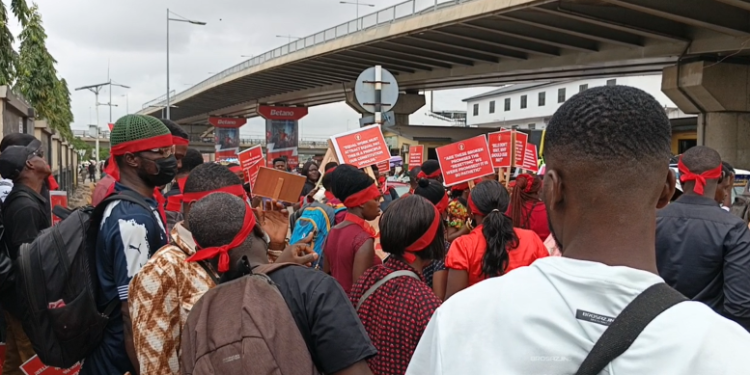
Some teachers from the 2022 cohort of Colleges of Education graduates have staged a protest over 14 months of unpaid salaries, demanding urgent action from the government.
The teachers say they have been waiting for their salaries since 2025 despite several engagements with relevant stakeholders, including the Ministry of Education, as well as a previous protest over the issue.
According to the group, the prolonged delay has placed significant financial strain on affected teachers, many of whom have accumulated debts while struggling to meet their basic needs.
The teachers are also demanding the issuance of staff identification cards to affected members who are yet to receive them.
As part of the protest, the group intends to petition the Ministry of Finance, the Jubilee House, the Ministry of Education and the Ghana Education Service to intervene and resolve the matter.
Speaking to Citi News, one of the affected teachers said the government’s failure to pay them had left many struggling to meet basic household expenses.
“The government intentionally paid some teachers and left some teachers. For the past 14 months, we have not been paid; we have accumulated debt upon debt. For some of us, paying electricity bills has become a problem; paying water bills has become a problem.
“In fact, we can’t even handle basic things; we can’t even buy boxer shorts for ourselves because we have accumulated so much debt to the extent that whenever we are paid our one-month salaries, our debtors come after us, taking our money,” he said.
The teachers are therefore calling on the government to settle all outstanding salaries and address the administrative challenges affecting their employment, including the delay in issuing staff identification cards.